

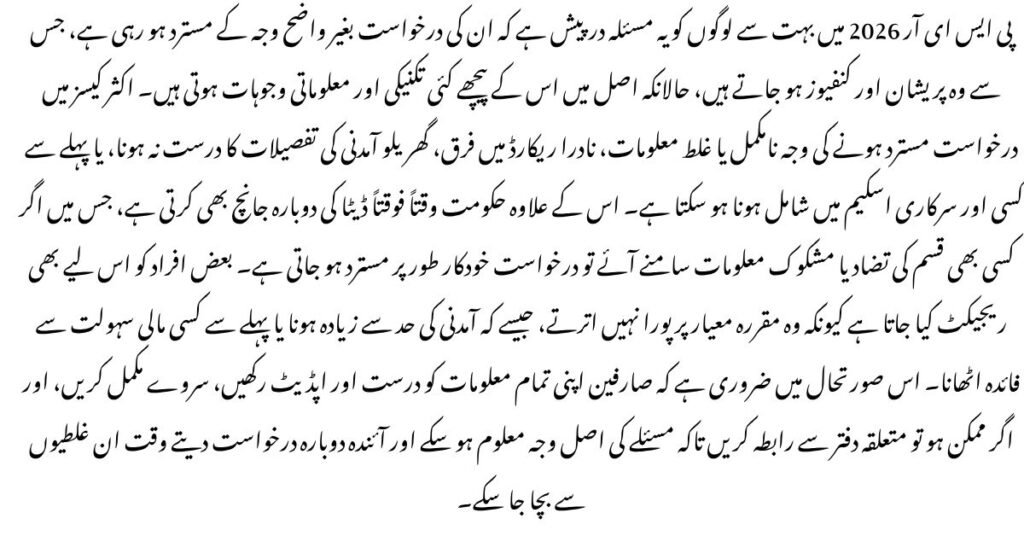
Many people apply for PSER 2026 Are You Getting Rejected Without Knowing Why but do not understand why their application gets rejected. The system usually does not give a clear reason, and which creates confusion and worry. Because of this, applicants often think they are not eligible, even when the real issue is small and fixable. If your application is rejected, it does not always mean and you are not deserving. In most cases, the rejection happens because of simple problems like wrong CNIC details, incomplete information, or mismatch in your data with government records. This guide will help you understand the real reasons behind rejection in a very easy way and show you how you can fix your application step by step.
Why is my PSER application rejected?
PSER applications are usually rejected because of the simple problems like wrong CNIC details, missing information, high income record, or wrong family details.To fix this, check your information carefully, correct any mistakes, complete the form properly, and apply again with correct details.
PSER 2026 – Quick Highlights
| Feature | Details |
| Program Name | PSER 2026 |
| Managed By | Punjab Government |
| Purpose | Identify deserving families for financial aid |
| Who Can Apply | Low-income households |
| Status Check | Online portal / SMS / Office |
| Common Issue | Incorrect data or high score |
| Reapply Option | Yes (after correction) |
| Verification | CNIC + household data |
| Approval Time | 2–6 weeks |
Latest Update 2026 – PSER System Changes
The government has introduced new updates in the PSER 2026 system to improve transparency and reduce fake registrations.
Important updates include:
- CNIC verification is now fully linked with NADRA records
- Duplicate applications are automatically rejected
- Household income is checked through digital survey system
- Data update is now required every year
- Faster rejection alerts are being sent to applicants
- Priority given to widows, disabled persons, and daily wage workers
If your application is rejected now, it is mostly due to new strict verification rules, not system error.
What is PSER and Why It Matters
PSER (Punjab Socio-Economic Registry) is a government database that collects household information.
This data is used to decide who will receive:
- Financial assistance
- Rashan support
- Subsidy programs
- Welfare schemes
If your data is incorrect, you may be marked ineligible automatically.
What to Do If You Keep Getting Rejected
If your application has been rejected multiple times:
- Visit your nearest PSER or government office
- Get your full data verified
- Request a re-evaluation if needed
- Seek help from a knowledgeable person for proper data review
- Sometimes the issue is not the system it’s your background data.
PSER vs Other Government Programs
If you are already enrolled in programs like:
- Ehsaas Program
- BISP
- Other subsidy schemes
Your priority in PSER may be reduced, as the system tries to distribute aid fairly.
Final Expert Advice
PSER 2026 is a data-driven system — decisions are based on records, not assumptions.
If:
- Your data is accurate
- Your records match
- Your information is complete
Your chances of approval are very high
But if:
- There are mismatches
- Income details are unclear
- Family data is incorrect
Rejection is likely to repeat
Quick Improvement Summary
- Accurate data
- Verified CNIC
- Realistic income
- Complete family details
- Single application only
Who is Eligible for PSER 2026?
You may qualify if:
- Low-income household
- No large property or business
- Limited monthly income
- Unemployed or daily wage worker
- Not receiving high-level government support
You may be rejected if:
- High income record
- Property or vehicle ownership
- Strong financial background
Hidden Reasons Your PSER Application Gets Rejected
Most applicants only see basic rejection reasons, but the system also checks some hidden factors:
- Your mobile number is already linked with another application
- A family member’s income is already registered in government data
- Your CNIC was previously marked as “financially stable” in an older survey
- High electricity or gas usage suggests a better financial condition
- These factors are not clearly shown, but they silently affect your eligibility score.
How the PSER Poverty Score Works
The PSER system uses a scoring model. Here’s an easy way to understand it:
- Higher income → higher score → more chances of rejection
- Larger family + lower resources → lower score → better chances of approval
- Type of job matters:
- Government job → higher score
- Daily wage work → lower score
- This means it’s not just income your overall living condition is evaluated.
How PSER Selection Works
PSER uses a poverty score system.
- Low score → Eligible
- High score → Rejected
It checks:
- Income level
- Family size
- CNIC record
- Property details
- Employment status
Even small mistakes can change your score.
How to Increase Your Chances of Approval
Follow these smart practices:
- Ensure CNIC and family data match official records
- Keep income realistic (not too low, not too high)
- Submit only one application
- Fill every field completely
- Keep your records updated and consistent
Simple rule:
Consistency leads to approval.
Benefits of PSER 2026 System
The PSER 2026 (Punjab Socio-Economic Registry) system is used to collect and check people’s data for government support programs.
1. Fair Selection:
PSER helps make sure only deserving and poor families get government help.
2. Easy Data Checking:
It keeps all family details in one system, so checking eligibility becomes simple and fast.
3. Less Mistakes:
Because data is digital, there are fewer chances of errors or wrong information.
4. Better Government Planning:
The government can be understood and who needs to help most and plan better support programs.
5. Transparency:
The system makes the process clear and fair, so there are less chances of fraud.
6. Proper Use of Resources:
Government aid is given only to right and needy people, so resources are not wasted.
Step-by-Step Data Correction Guide
If you want to improve your chances, follow this structured process:
1. Verify Your CNIC Data
- Check your family tree details
- Remove or correct any incorrect family member entries
2. Align Your Income Information
- Enter realistic income
- Extremely low or fake values can also trigger rejection
3. Review Utility Usage
- High electricity or gas usage may affect your score
- Keep records consistent with your declared income
4. Fix Family Details
- Ensure marital status and dependents are accurate
- Incorrect entries can increase your score unnecessarily
Top Reasons for PSER 2026 Rejection
1. CNIC Not Verified
Mismatch with NADRA data leads to rejection.
2. High Income Score
The system shows you as financially stable.
3. Property Ownership
Land, house, or business ownership affects eligibility.
4. Incomplete Form
Missing details cause automatic rejection.
5. Wrong Family Information
Incorrect household data increases score.
6. Duplicate Application
Multiple entries from the same CNIC are blocked.
How to Check PSER Status
You can easily check your PSER application status using different methods. Just follow any of the options below:
1. Online Portal Method
- Open the official PSER website
- Enter your CNIC number
- Click on submit or check status
- Your result will appear on the screen
2. SMS Service Method
- Open your mobile message box
- Type your CNIC number
- Send it to the official PSER SMS code
- You will receive your status reply
3. Office Visit Method
- Visit the nearest PSER or government office
- Take your original CNIC with you
- Ask the staff to check your application status
- They will tell you the update
Status Result Meaning
After checking, your status will show one of these:
- Approved → Your application is accepted
- Under Review → Your data is still being checked
- Rejected → Your application is not approved
How to Fix a Rejected PSER Application
If your PSER application is rejected, and you don’t worry. You can fix it by the following simple steps one by one.
Step 1: Check Error Reason
First, check why your application was rejected. It is usually because of small mistakes or missing details.
Step 2: Review Your Data
Carefully check all your details such as:
- CNIC number
- Income information
- Family details
- Address information
Step 3: Correct Mistakes
Fix any wrong or missing information in your application. Make sure everything is accurate.
Step 4: Update Records
Make sure your NADRA record is correct and up to date because the system uses it for checking and verification.
Step 5: Reapply
After fixing all mistakes, submit your application again with correct information.
Step 6: Wait for Verification
After reapplying, wait for the verification process to complete. Do not submit the application again and again.
Common Problems and Solutions
| Problem | Reason | Solution |
| CNIC not verified | Data mismatch | Update NADRA record |
| Application rejected | High score | Correct income details |
| Missing eligibility | Incomplete form | Fill all fields |
| Family data error | Wrong details | Update household info |
| Status delay | System load | Wait and recheck |
| Duplicate record | Multiple applications | Keep one entry |
| Verification pending | Under review | Wait for approval |
Can You Reapply After Rejection?
Yes.
But only after:
- Fixing all errors
- Updating correct data
- Verifying CNIC details
Otherwise, rejection will repeat.
Common Mistakes Checklist
Avoid:
- Wrong CNIC
- Fake income details
- Missing fields
- Incorrect family data
- Outdated information
- Multiple applications
Many applicants make the same errors again and again:
- Reapplying without fixing previous mistakes
- Letting untrained agents fill out the form incorrectly
- Providing false information to appear “eligible”
- Submitting multiple applications with the same CNIC
- This creates a pattern of rejection in the system.
Tips to Avoid PSER Rejection
- Use correct CNIC data
- Enter real income details
- Include full family information
- Double-check before submitting
- Keep records updated
- Apply only once
How Many Times Is It Safe to Reapply?
- First attempt → Normal
- Second attempt (after correction) → Recommended
- Third attempt without changes → Risky
Best approach:
Always review and correct your data before reapplying.
Final Thoughts
PSER rejection is not random. It usually happens because of the simple but very important issues like wrong data, eligibility problems, or verification checks in the system. When your information does not match official records or is incomplete, the system can automatically reject your application.In 2026, the PSER system has become more strict and advanced. Now it checks data more carefully, including CNIC details, income information, and household records. Even small mistakes can affect your result.That is why accuracy is very important. If you enter correct and updated information, and your records match with government data, your chances of approval become much higher.
FAQ Section
Q: Why is my PSER application rejected?
Ans:Mostly due to incorrect data, high income score, or verification failure.
Q: Can I apply again after rejection?
Ans:Yes, after correcting your details.
Q: What is new in PSER 2026?
Ans:Stricter CNIC verification, duplicate blocking, and updated digital survey system.
Q: How long does approval take?
Ans: Usually 2–6 weeks depending on verification.
Q: How can I improve approval chances?
Ans: Provide accurate and updated information.