
The demand for solar energy is growing rapidly in 2026. Rising electricity prices and increasing interest in renewable energy have pushed millions of families toward government-backed solar panel schemes.But after applying, one question is becoming extremely common:“How can I check my solar panel application status using CNIC?”This has become one of the biggest trending searches related to solar programs in 2026.Many applicants feel confused because they do not know whether:
- Their application was approved
- Verification is complete
- Documents were accepted
- Technical inspection passed
- Installation is scheduled
The good news is that modern digital systems now allow applicants to track solar applications easily using their CNIC numbers. This complete guide explains the latest solar panel status check CNIC method in simple English.
You will learn:
- How to check solar scheme status online
- SMS tracking methods
- Common verification issues
- Approval stages
- How to fix rejected applications
- Important 2026 updates
Families are already excited because solar support programs are expanding faster than ever before. This is becoming a major moment in the clean energy transition.
What Is the Solar Panel Status Check CNIC Method?
The solar panel status check CNIC method is a digital verification system that allows applicants to track their solar application using their national identity card number. Instead of visiting offices repeatedly, users can now check:
- Application progress
- Approval status
- Eligibility confirmation
- Verification updates
- Technical survey progress
- Installation scheduling
The solar panel status check CNIC method allows applicants to verify their solar scheme application by entering their CNIC number into the official portal or SMS system connected to the solar program. This system was introduced to improve transparency and reduce delays.
Read More Detail : Stay Updated with Every Govt Scheme & Relief Program
Latest Solar Scheme Update 2026
A huge update arrived in 2026 for solar applicants. Authorities upgraded verification systems using:
- AI-powered screening
- Digital CNIC validation
- Electricity bill matching
- Biometric verification
- Duplicate application detection
This historic digital shift made the process faster but also stricter. Applications are now reviewed automatically in many cases. Another major update is that applicants can now receive:
- SMS alerts
- Real-time status tracking
- Online verification updates
- Technical inspection notifications
This has made the solar application process easier for millions of households.
Why CNIC Verification Is Important
CNIC verification plays a critical role in solar scheme approval. Authorities use CNIC records to confirm:
- Applicant identity
- Family registration
- Eligibility level
- Address details
- Welfare database records
- Electricity consumer matching
If CNIC records are incorrect, the application may face:
- Delays
- Rejection
- Pending verification status
CNIC verification is important because solar schemes use identity records to confirm eligibility, prevent fraud, and match electricity consumer details with the applicant’s information.Many applicants ignore small mistakes in their records, but even minor mismatches can create serious delays.
How to Check Solar Panel Status Using CNIC
Checking solar application status is now much easier in 2026. Most programs offer multiple methods.
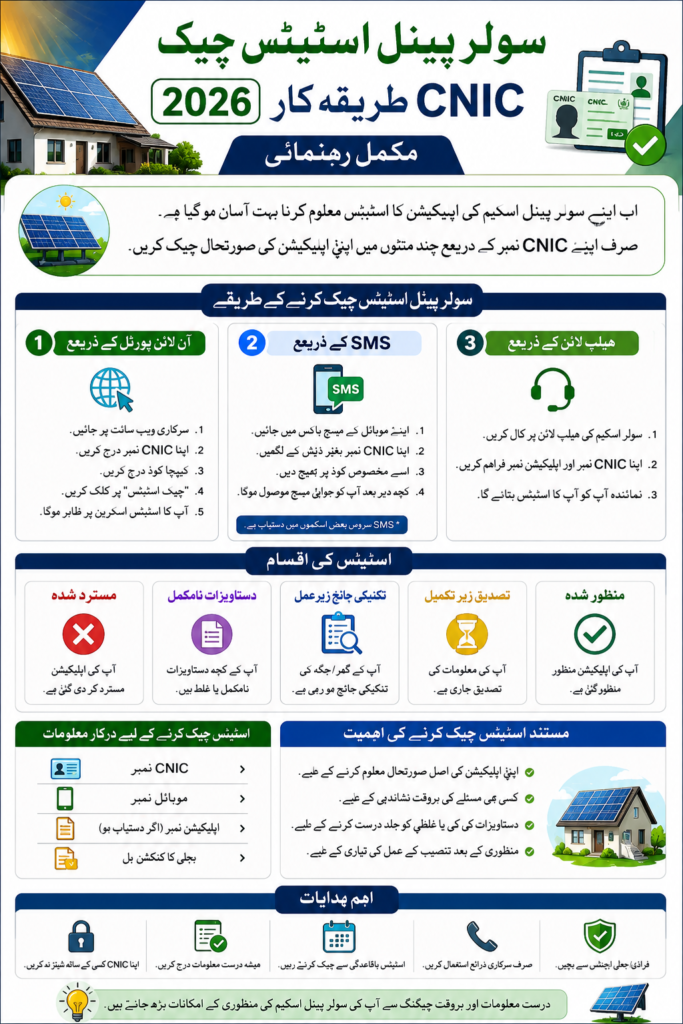
Method 1 :Online Portal Check
This is the most popular method.
- Open the official solar scheme portal
- Enter your CNIC number
- Add verification code if required
- Click the status check button
- View application result
Possible status results include:
- Approved
- Under Review
- Verification Pending
- Rejected
- Technical Survey Pending
Method 2 :SMS Status Check
Many solar programs now provide SMS verification systems.
- Open your mobile messaging app
- Type your CNIC number
- Send it to the official solar scheme code
- Wait for response message
The system may return:
- Approval updates
- Eligibility confirmation
- Verification status
- Missing document alerts
The SMS CNIC method allows applicants to check solar application status by sending their CNIC number to the official verification code linked with the scheme.This method is especially useful for rural areas with limited internet access.
Method 3 :Helpline Verification
Applicants can also use customer support systems. Required details usually include:
- CNIC number
- Mobile number
- Application ID
- Electricity consumer ID
Support agents may provide:
- Verification details
- Application stage updates
- Technical survey information
Documents Required for Verification
Applicants should keep important documents ready before checking status.
| Required Document | Purpose |
| CNIC | Identity verification |
| Electricity bill | Consumer validation |
| Mobile number | OTP confirmation |
| Application number | Status tracking |
| Property information | Installation verification |
Missing information may prevent successful tracking.
Common Problems During Status Check
Many users experience issues while checking application status.
1. Invalid CNIC Error
This happens when:
- CNIC digits are incorrect
- CNIC expired
- Verification database not updated
2. Application Not Found
Possible reasons include:
- Application not submitted successfully
- Wrong application ID
- Server delay
- Pending registration upload
3. Verification Pending Status
This usually means:
- Documents still under review
- Biometric verification incomplete
- Electricity bill matching pending
4. Technical Survey Delay
Technical inspections sometimes take extra time because of:
- High application volume
- Area verification delays
- Limited inspection teams
How to Fix CNIC Verification Issues
Many verification problems can be solved easily.
Step 1 :Verify CNIC Details
Ensure:
- CNIC is valid
- Name spelling is correct
- Address matches records
Step 2 :Update Expired CNIC
Expired identity cards often trigger automatic rejection. Renew documents immediately if needed.
Step 3 :Match Electricity Bill Records
The electricity bill should ideally match:
- Applicant name
- Address details
- Consumer information
Step 4 :Complete Biometric Verification
Some applicants must complete fingerprint verification before approval.
Read More Detail : Stay Updated with Every Govt Scheme & Relief Program
Solar Application Approval Process
Understanding the approval process helps applicants track progress properly.
- Registration Submission
- CNIC Verification
- Electricity Bill Matching
- Eligibility Review
- Technical Survey
- Final Approval
- Installation Scheduling
Each stage may take several days depending on application volume.
Solar Scheme Eligibility Criteria
Most solar programs prioritize households with genuine financial need. Common eligibility conditions include:
- Valid CNIC
- Active electricity connection
- No major unpaid bills
- Eligible income category
- Residential property verification
Some schemes also prioritize:
- Rural areas
- Low-income families
- High electricity usage households
Important Tips for Faster Approval
- Use Correct Information :Even small mistakes can delay approval.
- Keep Documents Updated :Expired documents create verification problems.
- Use Your Own Mobile Number :This improves OTP and communication success.
- Avoid Duplicate Applications :Multiple submissions may trigger automatic rejection.
- Check Status Regularly :Regular tracking helps identify issues early.
Common Mistakes Applicants Make
Many people unknowingly make simple mistakes during registration.
- Wrong CNIC number
- Incorrect electricity bill upload
- Inactive mobile number
- Duplicate applications
- Blurry document images
- Incorrect address details
Avoiding these mistakes greatly improves approval chances.
Future of Solar Schemes in 2026
Solar programs are expected to expand rapidly in the coming years. Governments are investing heavily in:
- Renewable energy
- Smart electricity systems
- Solar financing support
- Rural electrification
- Green energy infrastructure
Experts predict future schemes may include:
- Solar batteries
- Smart meters
- AI-powered energy monitoring
- Faster online approvals
- Expanded net metering systems
This transition is becoming one of the biggest energy changes in modern history. Millions of households are already excited about reducing electricity costs through solar energy.
Expert Analysis
Experts believe the CNIC-based digital verification system is improving transparency in solar programs. The biggest advantage is speed. Applications that previously took months can now move faster through automated screening. However, experts also warn that applicants must become more careful with documentation. Small errors now trigger automatic delays more quickly than before. The strongest recommendation from experts is simple:
- Submit accurate information
- Keep records updated
- Monitor status regularly
- Avoid third-party fraud agents
Awareness is now essential for successful approval.
FAQs
How can I check solar panel status using CNIC?
You can check status through the official online portal, SMS verification system, or solar helpline services.
Why is my solar application still pending?
Applications may remain pending because of document review, biometric verification, or technical survey delays.
Can I check solar status without the internet?
Yes. Many schemes provide SMS verification services using CNIC numbers.
What does verification pending mean?
It means authorities are still reviewing your documents or matching your records.
Can duplicate applications cause rejection?
Yes. Multiple applications from the same household may trigger automatic rejection systems.
How long does solar approval take in 2026?
Approval time depends on verification stages and application volume. Some cases finish within weeks, while others take longer.
Is electricity bill verification necessary?
Yes. Most schemes require active electricity connections and valid consumer records.
Can rejected applications be corrected?
Many schemes allow re-verification or fresh submission after fixing errors.
Final Thoughts:
The solar panel status check CNIC method has made solar application tracking much easier in 2026. Applicants can now monitor:
- Verification progress
- Eligibility status
- Approval updates
- Technical inspections
- Installation stages
This digital transformation is helping millions of households access cleaner and more affordable energy solutions.The most important thing is accuracy.Applicants who submit correct documents, maintain updated records, and regularly check their status have a much higher chance of successful approval.As solar energy programs continue expanding, CNIC-based verification systems will become even more important for faster and more transparent application processing in the future.