
The demand for solar Solar Panel Scheme Rejection Reasons energy is growing rapidly in 2026. Rising electricity bills, energy shortages, and government support programs have pushed millions of families to apply for free or subsidized solar panel schemes. But there is one major issue many applicants are now facing: rejection. Thousands of people submitted applications with high hopes, only to receive rejection messages later. Many families are confused because they believe they completed everything correctly. This has become a huge topic online as people search for the real solar panel scheme rejection reason 2026.The good news is that most rejections happen because of simple mistakes. In many cases, the problem can still be fixed. Fans of renewable energy and household consumers are already excited because governments are expanding solar support programs faster than ever before. This is becoming a big moment in clean energy history. In this complete guide, you will learn:
- Why solar applications are rejected
- How to avoid mistakes
- How to fix verification issues
- What documents are required
- How approval systems work in 2026
- What applicants should do next
What Is the Solar Panel Scheme 2026?
The solar panel scheme 2026 is a government-supported energy assistance program designed to help households shift toward renewable electricity. Under these schemes, eligible families may receive:
- Free solar panels
- Subsidized installation
- Easy financing options
- Reduced electricity bills
- Net metering support
- Solar batteries in some cases
The main goal is simple:
Reduce pressure on national electricity systems while helping families save money. Many low-income and middle-income households are applying because electricity prices continue to increase.
Read More Detail : Stay Updated with Every Govt Scheme & Relief Program
Latest Solar Scheme Update 2026
A major update in 2026 changed how applications are verified. Authorities are now using:
- Digital CNIC verification
- Electricity consumption tracking
- Property ownership checks
- Biometric confirmation
- Duplicate application detection systems
This new system is faster but stricter.
Applicants with incomplete records are now more likely to face rejection. Another major update is that priority is being given to:
- Low-income households
- High electricity bill consumers
- Rural areas with energy shortages
- Families already registered in welfare databases
Because of these new verification systems, many applications are being rejected automatically.
Major Solar Panel Scheme Rejection Reasons 2026
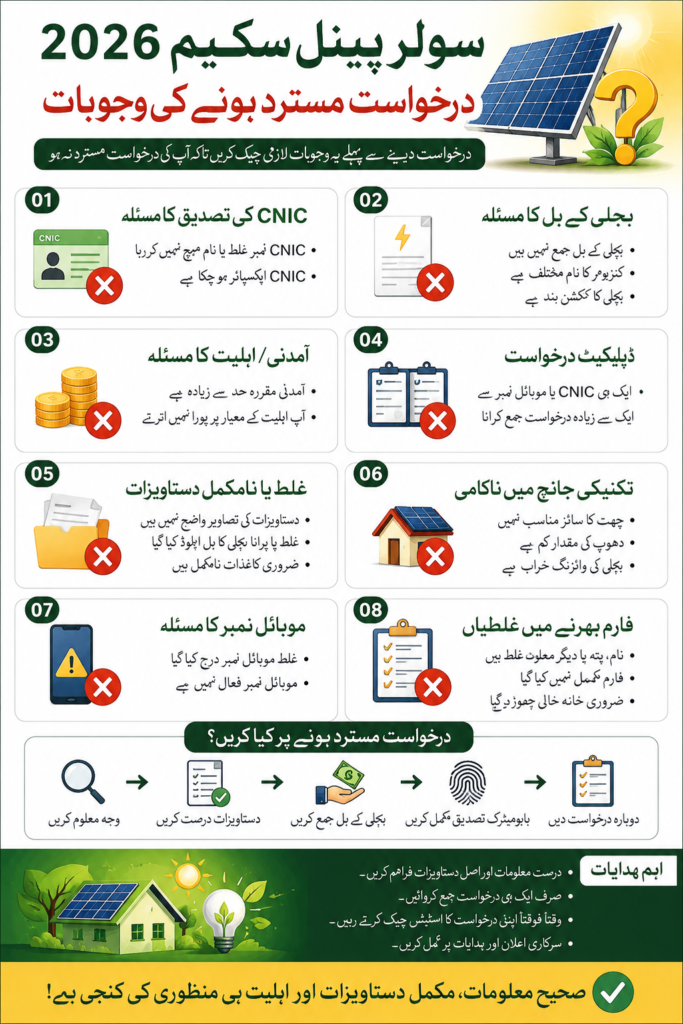
Most solar panel scheme applications are rejected because of incorrect documents, CNIC mismatches, unpaid electricity bills, duplicate registrations, or eligibility problems. Below are the biggest rejection reasons in detail.
1. CNIC Verification Problems
One of the most common rejection reasons is CNIC verification failure. If your CNIC details do not match government records, the application may automatically fail. Common CNIC problems include:
- Expired CNIC
- Wrong CNIC number entered
- Family registration mismatch
- Biometric verification issues
- Different address records
How to Fix It
- Renew expired CNIC immediately
- Correct spelling mistakes
- Verify family registration details
- Complete biometric verification again
Many applicants ignore small spelling mistakes, but even tiny errors can trigger rejection.
2. Electricity Bill Issues
Electricity verification will become extremely strict in 2026. Authorities now check:
- Monthly electricity usage
- Bill payment history
- Meter ownership
- Consumer ID validity
Applications may get rejected if:
- Bills are unpaid
- Meter is disconnected
- Consumer name does not match applicant
- Electricity usage is too low
- Fake bill copies are submitted
If your electricity bill record is incomplete or unpaid, your solar panel scheme application may be rejected during digital verification. Applicants should ensure their electricity connection is active and registered under the correct name before applying.
3. Income and Eligibility Problems
Many schemes are designed only for low-income households. Applications may be rejected if the system detects:
- High income records
- Luxury property ownership
- Multiple businesses
- Large tax records
- Ineligibility in welfare databases
Some people unknowingly apply even though they do not qualify under the latest policy rules.
Important Update
In 2026, income screening systems became more advanced. Cross-checking now happens automatically through national databases.
4. Duplicate Applications
Duplicate applications are becoming a major issue. Some families apply multiple times using:
- Different phone numbers
- Multiple family members
- Duplicate CNIC entries
The system can now detect repeated applications quickly. Once duplication is detected, applications may be:
- Blocked
- Delayed
- Permanently rejected
How to Avoid This
Submit only one application per household unless official guidelines clearly allow otherwise.
5. Incorrect Documents Submission
Document mistakes are one of the biggest reasons behind rejection.
Common errors include:
| Document Problem | Impact |
| Blurry CNIC copy | Verification failure |
| Wrong electricity bill | Consumer mismatch |
| Old documents | Expired record issue |
| Fake information | Permanent disqualification |
| Missing signatures | Incomplete application |
| Incorrect phone number | Communication failure |
Even a small upload issue can stop approval. Applicants should always double-check every file before submission.
6. Technical Verification Failure
In some areas, technical surveys are conducted before approval. Applications may fail if:
- Roof size is too small
- Building structure is unsafe
- Sunlight exposure is poor
- Installation area is blocked
- Electrical wiring is damaged
This is especially important for large solar installations.
What Is Technical Verification?
Technical verification checks whether your home can safely support a solar system installation. This process usually includes:
- Roof inspection
- Wiring evaluation
- Meter compatibility
- Sunlight analysis
7. Invalid Mobile Number
Many applicants enter incorrect phone numbers during registration. This creates major issues because:
- OTP verification fails
- Status updates are missed
- Approval messages are not received
Always use an active mobile number registered in your own name.
8. Application Form Mistakes
Simple form mistakes can also cause rejection.
Examples include:
- Wrong spelling
- Incorrect address
- Missing fields
- Invalid district selection
- Typing errors in consumer ID
These mistakes may look small, but automated systems treat them seriously.
Read more Detail : Stay Updated with Every Govt Scheme & Relief Program
How to Fix Rejected Solar Applications
Most rejected solar applications can be corrected by updating documents, fixing CNIC records, clearing electricity dues, and resubmitting accurate information.
Step 1: Identify the Rejection Reason
Check:
- SMS alerts
- Online portal notifications
- Helpline messages
Understanding the exact issue is very important.
Step 2: Correct Documents
Update:
- CNIC copy
- Electricity bill
- Mobile number
- Income information
Ensure everything matches official records.
Step 3: Clear Pending Bills
If unpaid electricity bills exist:
- Pay dues immediately
- Save payment receipts
- Wait for billing system updates
Step 4: Complete Biometric Verification
Some applications remain pending because biometric verification is incomplete. Visit the nearest verification center if needed.
Step 5: Submit Appeal or Reapply
Many schemes allow:
- Appeal requests
- Re-verification
- Fresh applications after correction
Always follow the latest official instructions.
How to Check Solar Scheme Status
Most programs now provide digital tracking systems. Applicants can usually check status through:
- SMS services
- Online portals
- Helpline systems
- Consumer dashboards
Common Status Messages
| Status | Meaning |
| Under Review | Application being checked |
| Verification Pending | Documents not completed |
| Approved | Eligible for installation |
| Rejected | Application failed |
| Technical Survey Pending | Site inspection required |
Solar Scheme Approval Process
The approval process generally follows these steps:
- Registration
- Document Upload
- CNIC Verification
- Electricity Bill Verification
- Eligibility Screening
- Technical Survey
- Final Approval
- Solar Installation
Understanding this process helps applicants avoid panic during delays.
Common Mistakes People Make
Many applications fail because people rush the process. Here are the most common mistakes:
- Uploading low-quality images
- Using another person’s electricity bill
- Entering incorrect CNIC digits
- Applying multiple times
- Ignoring eligibility rules
- Missing deadlines
- Not checking SMS updates
Avoiding these mistakes can dramatically improve approval chances.
Expert Tips to Avoid Rejection
- Keep Documents Updated :Ensure all records are current before applying.
- Use Accurate Information :Never use fake details. Digital systems are now extremely advanced.
- Pay Bills on Time :Payment history plays a major role in approval.
- Use Your Own SIM Card :The mobile number should ideally match your CNIC.
- Avoid Multiple Applications :Duplicate entries increase rejection risk.
Read More Detail : Stay Updated with Every Govt Scheme & Relief Program
Future of Solar Energy Programs
Solar energy support programs are expected to expand even more after 2026. Governments are focusing heavily on:
- Renewable energy
- Reduced fuel dependency
- Lower electricity shortages
- Climate-friendly systems
Experts believe future schemes may include:
- Solar batteries
- Smart meters
- AI-powered energy monitoring
- Expanded net metering
- Rural solar grids
This is becoming one of the biggest energy transitions in modern history. Families are already excited because solar systems can reduce electricity bills for many years.
Expert Analysis
Energy experts believe rejection rates increased in 2026 mainly because digital verification systems became stronger.The good side is that these systems reduce fraud and improve transparency. However, many genuine applicants still struggle because they are unaware of updated rules.
Experts recommend:
- Reading eligibility instructions carefully
- Keeping official documents ready
- Tracking application updates regularly
- Avoiding third-party agents
Awareness is now the key to successful approval.
FAQs
Why was my solar panel scheme application rejected in 2026?
Most applications are rejected because of CNIC issues, unpaid electricity bills, duplicate applications, or incorrect documents.
Can I apply again after rejection?
Yes, many schemes allow reapplication after correcting the identified issue.
Does unpaid electricity bill affect solar approval?
Yes. Pending electricity dues are one of the biggest rejection reasons in 2026.
How long does solar verification take?
Verification may take from a few days to several weeks depending on application volume and technical inspection requirements.
Is biometric verification necessary?
Some schemes require biometric confirmation to prevent fraud and duplicate registrations.
Can tenants apply for solar schemes?
Some programs only allow property owners, while others may permit tenants with proper authorization.
What documents are required for solar schemes?
Usually required documents include:
Income verification
CNIC
Electricity bill
Mobile number
Property details
How can I improve approval chances?
Use accurate information, clear pending bills, upload valid documents, and avoid duplicate applications.
Are solar schemes free in 2026?
Some schemes offer free systems, while others provide subsidies or installment plans.
Final Thoughts:
The solar panel scheme rejection reason 2026 issue has become a major concern for many families. But in most cases, rejection happens because of simple and fixable mistakes. The biggest problems include:
- CNIC mismatches
- Electricity verification issues
- Duplicate applications
- Incorrect documents
- Eligibility failures
The good news is that careful preparation can greatly improve approval chances.
As renewable energy programs continue expanding, solar systems are becoming one of the most important solutions for rising electricity costs.Families who stay informed, follow official rules, and submit accurate applications will have a much better chance of approval in 2026 and