
The CM laptop scheme verification process 2026 is an important system designed to ensure that laptops are distributed fairly among deserving students. This program helps students in higher education by providing free or subsidized laptops to support digital learning, research, and academic development. In 2026, the verification process will become more advanced, digital, and transparent. Students can now check their application status online, track verification stages, and receive updates without visiting offices. This has made the system faster and more student-friendly.
What is CM Laptop Scheme Verification Process 2026
The CM laptop scheme verification process 2026 is a digital checking system used by government authorities to confirm student eligibility before laptop distribution.
The CM laptop scheme verification process 2026 is a government system that checks student eligibility, academic records, and CNIC details before approving free laptop distribution. It ensures only deserving students receive laptops through a transparent online verification and tracking system.
Read More Detail : Stay Updated with Every Govt Scheme & Relief Program
Latest Update 2026
In 2026, the verification system will be improved for faster processing and better accuracy.
- Fully digital verification system
- Faster CNIC validation
- University-based data integration
- Real-time application tracking
- Reduced manual paperwork
- Improved merit-based selection
These updates help students get faster results and reduce delays.
Eligibility Criteria
Students must meet these conditions:
- Valid CNIC or B-form
- Enrolled in recognized university
- Good academic performance
- Regular attendance record
- First-time applicant (in most cases)
Priority is given to high-achieving students in public universities.
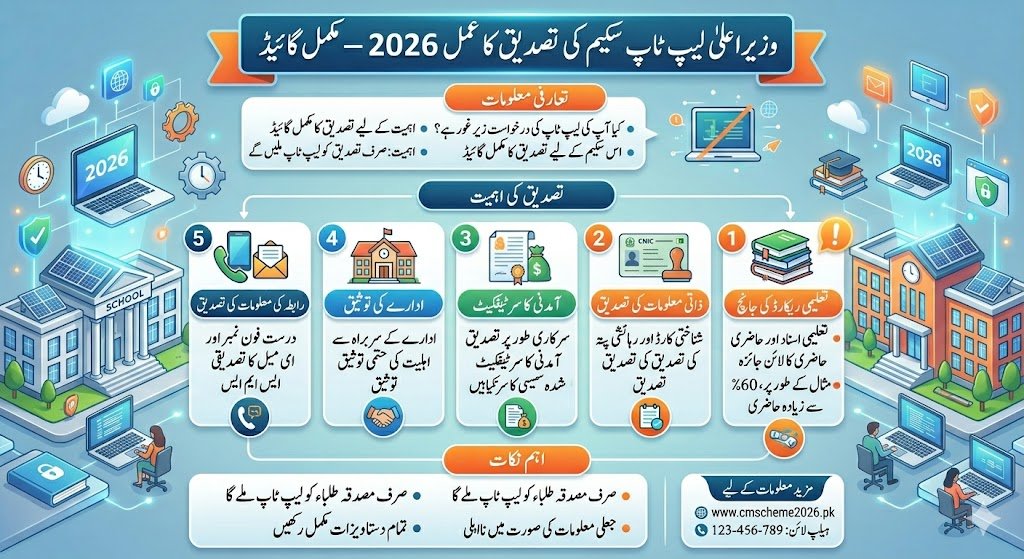
Step-by-Step Verification Process
Step 1: Application Submission
Students first apply through the official CM laptop scheme portal or their university’s internal system. In this step, they are required to enter personal details such as name, CNIC, university information, and academic program. They also upload necessary documents to complete the application. This step is very important because any incorrect or incomplete information can delay the verification process later.
Step 2: Data Matching
After submission, the system automatically matches the student’s details with official university records. This includes checking enrollment status, department information, and academic year. The purpose of this step is to ensure that only genuine and currently enrolled students move forward in the process. If any mismatch is found, the application may be put on hold for correction.
Step 3: CNIC Verification
In this stage, the student’s CNIC is verified through national database systems. This ensures identity accuracy and prevents duplicate or fake registrations. The system checks whether the CNIC is valid, active, and correctly linked with the applicant’s personal information. Any inconsistency may require additional verification or document resubmission.
Step 4: Academic Check
Once identity is confirmed, the system reviews academic performance. This includes checking marks, attendance records, and overall enrollment status. The purpose of this step is to ensure that the applicant meets the required academic standards for the laptop scheme. Students with consistent performance and good academic standing are prioritized.
Step 5: Merit Evaluation
After academic verification, students are ranked based on merit. This evaluation considers marks, university performance, and sometimes program level. Higher-performing students are placed at the top of the list. This step ensures fairness and transparency so that laptops are awarded to the most deserving candidates.
Step 6: Final Approval
In the final stage, selected students are officially approved for laptop distribution. Their names are added to the final list, and they are notified through the system or university channels. After approval, students receive further instructions regarding laptop distribution events or collection points. This step completes the verification process successfully.
Required Documents
- CNIC or B-form
- University enrollment proof
- Academic transcripts
- Recent passport-size photo
- Student ID card
Correct documents are essential for smooth verification.
Read More Detail : Stay Updated with Every Govt Scheme & Relief Program
Application Status Tracking
Students can track their application status online:
- Pending verification
- Under review
- Approved
- Rejected
- Selected for distribution
Each stage gives clear updates to students.
Common Verification Issues
Some students face delays due to:
- Incorrect CNIC details
- Missing academic records
- University data mismatch
- Incomplete application form
- System overload during peak time
Most issues are fixable by correcting documents.
Approval Timeline
- Basic verification: 3–7 days
- Academic review: 1–2 weeks
- Final selection: 2–4 weeks
Timelines may vary depending on application volume.
Read More Detail : Stay Updated with Every Govt Scheme & Relief Program
Tips for Faster Approval
- Enter correct CNIC details
- Upload clear documents
- Ensure academic record is updated
- Apply through official portal only
- Avoid duplicate applications
Small mistakes can delay approval, so accuracy is important.
FAQs
1. What is CM laptop scheme verification process 2026?
It is a system that checks student eligibility before giving laptops under government programs.
2. Who is eligible for the laptop scheme?
University students with good academic performance and valid CNIC are eligible.
3. How can I check my status?
You can track your application through the official verification system.
4. Why is verification delayed?
Delays happen due to missing documents or data mismatch.
5. Is the scheme merit-based?
Yes, selection is mostly based on academic performance.
6. How long does approval take?
It usually takes 1 to 4 weeks depending on verification stages.
Final Summary:
The CM laptop scheme verification process 2026 is a fully transparent and digitally advanced system designed to support students in higher education by ensuring fair and merit-based distribution of laptops. This system helps the government verify each applicant’s eligibility through accurate digital records, reducing manual errors and making the entire process more reliable and efficient. With upgraded online verification tools, faster data processing, and real-time tracking features, students can now easily monitor every stage of their application from submission to final approval without unnecessary delays or confusion. This modern approach not only improves transparency but also builds trust among students by ensuring that deserving candidates are selected fairly. Overall, this initiative plays a very important role in promoting digital education, strengthening academic opportunities, and helping students achieve better performance in their studies through improved access to technology.